The Column

Showing posts with label trends. Show all posts

Thursday, February 10, 2011

Cloud Computing 101: A starter's toolkit

Here I try to cut some of the mystery out of cloud computing ... or maybe really muddy the waters up some more.


Excerpt:

"Here's the beauty of cloud computing: You can conceivably get by without a hard drive at all. Shoot, all you really need for cloud computing is an operating system, Web connection and browser, and perhaps a USB thumb drive for local storage. If you want to do it like a real geek, put your operating system and Web browser on the thumb drive and boot off that. Hard drive? What's a hard drive?"

###

Tuesday, February 8, 2011

Majority of mortgages are underwater in Vegas, other growth areas

Where are people losing their butts on their mortgages these days?

I found this in USA TODAY, and it shows that a tick more than 71 percent of the mortgages in Clark County, Nevada, are underwater. That means more is owed on the house than what the house is actually worth.

Clark County, where you'll find places like Las Vegas and Laughlin, has also been one of the highest-growth areas of the country for at least the past decade.

Here is a partial list of counties where home buyers might do well to just junk the mortgage, take whatever lumps they get on their credit ratings, and walk away with what's left of their posteriors:

RankCountyState
Mortgages under water
1ClarkNev.
71.1%
2OsceolaFla.
66.5%
3MercedCalif.
63.1%
4St LucieFla.
62.4%
5San JoaquinCalif.
59.6%
6StanislausCalif.
57.5%
7ClaytonGa.
56.1%
8OrangeFla.
56.1%
9SolanoCalif.
55.6%
10MaricopaAriz.
54.4%
11WashoeNev.
53.3%
12PinalAriz.
52.6%
13FlaglerFla.
52.5%
14PascoFla.
51.5%
15RiversideCalif.
50.5%


Interesting mix. A whole lot of Florida. Several counties in California -- including Riverside County, where I grew up. Several Arizona counties, particularly around the population centers -- Maricopa County is basically Phoenix.

And unless I'm mistaken, nearly every one of these counties has experienced off-the-charts population growth for about the past three decades. The Inland Empire, which encompasses Riverside and San Bernardino Counties, was THE high-growth capital in the nation before the Las Vegas metro area took over.

Coincidence? Forget it. There ain't no such animal, you should know that.


Sunday, July 25, 2010

Survey: A majority of phone users have ditched the landline


Found this in Consumerist, and it gives an idea of how the times are a-changing. In an informal, admittedly nonscientific poll, more than half of respondents said they no longer have one of those home phones that comes with wires. Not even a cordless phone.

Cell phones have taken over.


Do You Still Use Your Land Line?: 


According to a recently released study, there are more than 5 billion cell phones in use around the world today, with 20% of those just coming into use in the last 18 months. More and more, people are either ditching their traditional land lines or relegating it to a secondary role, especially in large metropolitan areas.

A few months ago, when we polled readers on whether or not they still needed their physical White Pages phone book anymore, an overwhelming number of respondents voted 'no.'

So, in the interest of pseudo-science, we now want to know just how frequently you use your land line compared to your mobile -- or if you even have a land line at all anymore.


Take the survey: How Frequently Do You Use Your Land Line?

Over 5 billion mobile phone connections worldwide [BBC]


Of course, I had to take this survey, and as soon as I put my answer in I grabbed the results:

In all, 4,479 people voted in this poll.

- It's my main mode of telephonic communication -- 14 percent (643).

- As frequently as I use my cell phone -- 11 percent (499 votes).

- My cell is the main phone, but I use the land line on occasion -- 23 percent (1,010 votes).

- What's a land line? -- 52 percent (2,327 votes).

By the way, I am one of those who does not have a land line. Got rid of it seven or eight years ago, after realizing the only calls I got on it were telemarketers. My parents thought that was funny, and they thought it was even funnier that their attorney uses a cell phone for home and office use.

Landlines? We don't need no steenkin' landlines.

(By the way, I still keep a current phone directory in my office. Can't remember when I last used the white pages, though.)

###


Sending aggressive-sounding emails? There's a (Windows) app for that


OK, so you're sending snarky emails in the heat of the moment? Maybe you told off a co-worker or your boss in an interoffice communication? Or worse, had the mother of all rectal-cranial inversions and told your spouse where to get off in an email?

I ran into this in lifehacker.com:

ToneCheck Stops You from Sending Passive Aggressive (or Plain Aggressive) Emails

Here's an excerpt:

ToneCheck is an email plug-in that checks the content of your emails for tone and alerts you to language that may be misunderstood or interpreted as particularly negative ... let's face it: Sometimes you send an email that you fully intend to convey anger or annoyance. But text communication is rife with misunderstandings, and often an email with perfectly pleasant intentions can lead to a lot of upset coworkers. That's what ToneCheck aims to address.

I find this a little disturbing, actually. Let's get in the toboggan and ride the slippery slope for a minute: I can see versions of this that can plug into your word processor, and screen out any language that is not deemed politically correct. Under that scenario, I might be tripping that alarm an awful lot.

Right now, it's in beta and during this period it is free. So far, this works only with Windows systems running Outlook, though I understand other versions are in the pipeline.

I don't think I'll be beta-testing this one.

###


Saturday, July 17, 2010

Of newspapers, pop tarts and Lady Gaga

In case you're wondering whatever happened to the industry they call "journalism," here's a rather amusing (yet true) take by the Washington Post:

Gene Weingarten - Gene Weingarten column mentions Lady Gaga.

Here's an excerpt, and I totally relate to what Weingarten says:

Call me a grumpy old codger, but I liked the old way better. For one thing, I used to have at least a rudimentary idea of how a newspaper got produced: On deadline, drunks with cigars wrote stories that were edited by constipated but knowledgeable people, then printed on paper by enormous machines operated by people with stupid hats and dirty faces ... everything is different today, and it's much more confusing. For one thing, there are no real deadlines anymore, because stories are constantly being updated for the Web. All stories are due now, and most of the constipated people are gone, replaced by multiplatform idea triage specialists. In this hectic environment, mistakes are more likely to be made, meaning that a story might identify Uzbekistan as "a subspecies of goat."


Weingarten gets into the business of writing headlines, too. A headline used to be written for human eyes, and liberties were occasionally taken with humor and taste. Like when my old editor, the late great Verne Peyser referred to the McDonalds shooting in San Ysidro (the one where the guy went nuts and killed more than 20 people) as "McMassacre." Or when the Fontana Herald-News ran the story of Redd Foxx' death with the headline "Fred joins Elizabeth." Now, that's headline writing.


Not any more. Here's what Weingarten says:


... even the best headlines will be changed to something dull but utilitarian. That's because, on the Web, headlines aren't designed to catch readers' eyes. They are designed for "search engine optimization," meaning that readers who are looking for information about something will find the story, giving the newspaper a coveted "eyeball." Putting well-known names in headlines is considered shrewd, even if creativity suffers ...


Which explains the Lady Gaga headline in the WaPo story. Weingarten mentioned the name of the pop tart du jour only peripherally, and that's what became the headline. And myself, well, I'm gonna put her in my headline too, just to see what happens.


Anyway, the whole industry has changed. If I showed up in a newsroom today, I wouldn't recognize it. Or like it.


I reckon I can complain about it. Back around 1990 I thought it was a horrible travesty when the newspaper where I was working formed focus groups among the community to shape our editorial policy. Shoot, accountants and doctors don't do this to determine how they're going to do business, are they?


But now see what's become of the news trade:


Recently some newspaper out around Pasadena outsourced much of their editorial work to ... people in India. Folks who don't speak the language, but they sure make a lot less than even a poorly-paid journalist stateside.


And news outlets like USA Today, the Atlanta Journal-Constitution, and SF Gate farm some of their work out to a huge Web content company. I can't complain about that; I do a lot of work for that particular Web content company (under an assumed name), and they do have a lot of good writers in their stable. But the copy is competent but colorless, and designed more for search engines than real live human readers.


Oh, yes. Extra points for mentioning pop idols; it gets them on the search engines faster.


###


(Photo: What's she doing in my newspaper? Photo by Billie Joe's Entourage.)


Monday, July 5, 2010

1995: Internet replace stores, books? You're kidding!


An Internet store? Never happen. (Image from sxc.hu)


Here's a blast from the past:


Back in 1995, the Internet was the Big New Thing. Folks were getting used to the idea that you can go to any library anywhere, "talk" to anyone, and experience some of the world without ever leaving your seat.


But to Clifford Stoll, it was just a fad. He offered his views in Newsweek early that year, saying that while the Internet was pretty cool, it wouldn't really catch on or be truly useful.


Stoll said:


"Do our computer pundits lack all common sense? The truth in no online database will replace your daily newspaper, no CD-ROM can take the place of a competent teacher and no computer network will change the way government works."


Stoll wasn't a technophobe. He'd been involved in the online world from the jump. Helped track down some computer crackers who stole military secrets and sold them to the KGB. And he has a little online business going now.


But back then, he knew computers would not replace books or newspapers. He knew it. Check it out:


"How about electronic publishing? Try reading a book on disc. At best, it's an unpleasant chore: the myopic glow of a clunky computer replaces the friendly pages of a book. And you can't tote that laptop to the beach. Yet Nicholas Negroponte, director of the MIT Media Lab, predicts that we'll soon buy books and newspapers straight over the Intenet. Uh, sure."


He said ecommerce wouldn't work all that well because, well, there's little human contact involved. Same thing with the rest of the Internet -- takes away that eyeball-to-eyeball. It's that same dynamic that author John Naisbitt pointed out in the 1982 book Megatrends -- that push-pull between high-tech and high-touch. 


Less than two decades after Naisbitt's book, and about five years after Stoll's predictions, high tech won the war.


Still, take a look at Stoll's Newsweek article. While you're about it, read the comments. The whole thing is a hoot. 


###


Link: Clifford Stoll's Web site.


Wednesday, May 26, 2010

HuffPo: Children are more likely to own a cell phone than a book


The numbers may be a little suspect, but it doesn't surprise me. 


I got this from The Huffington Post:


Children Are More Likely To Own A Cell Phone Than A Book, Study Says: "

Almost nine-in-10 pupils now have a mobile compared with fewer than three-quarters who have their own books in the home, it was disclosed ... the study by the National Literacy Trust suggested a link between regular access to books outside school and high test scores ... 


You can take this info and unpack it any way you like. We've already noticed kids don't read, and they grow up into adults who also don't read. Then they raise more children who don't read. Nothing new there.


Bottom line, parents: If you want your kids to read, set the example. Read to them. Read for yourself. Even if you grow up to be a totally evil uncool unhip parent (usually when the child hits about age 12), there's a chance some of that influence may stick. 


A generation ago, my friend Marco and I were bemoaning the popularity of Nintendo, which was the kiddie toy of the day. "We're raising a generation of Nintidiots," was how Marco put it.


But if Marco, a reader and guitar player, was reading this news article he might wonder how many of these pupils today have a guitar in their homes. And we're not talking about Guitar Hero either.


###


Tuesday, May 25, 2010

Does Facebook need its own anti-malware service?


I got this from ReadWriteWeb, and am running it in its entirety. It's interesting, even though the writers were too kind to Facebook. This, by the way, was a sponsored post--meaning it's pretty suspect. My comments are interjected below.


Does Facebook Need Its Own Anti-Malware Service?: "

Does Facebook need to run its own anti-virus and anti-malware security system? That's a question that may need to be addressed in the near future as the now almost 500 million users on the social networking service are facing regular attacks from rogue applications, phishing attempts and other sorts of hacks, not to mention the onslaught of viral, but often completely inaccurate reposted status messages that spread around the network like modern-day chain letters. These messages warn users about some supposed threat occurring on site, but are often either misguided or out-and-out lies.


Out and out lies, my butt. I spent about an hour chasing down something that a) sent random weird messages to my Facebook friends and b) was identified as malware by several excellent sources. This missive smacks of spin control to me.


Is it time for Facebook to step in and do more to protect its network and its users from threats like these?


Rogue Facebook Apps Top Rogue Anti-Spyware During Busy Weekend


The latest threat to make the rounds on Facebook is a rogue application dubbed 'Distracting Beach Babes.' The app compromised the security of thousands of users' accounts by way of status messages that appear to be from friends. But when the users click through on the tantalizing link, they're asked to give an application permission to run. The app then tells users they must update their 'FLV player' before they can see the video. Those that attempt to do so are sent off-site to another page where malware is installed on their computer.


This is hardly the first rogue application to take advantage of Facebook's automated app approval systems. In fact, only days ago, a similar attack was underway. This one was a link to what was purportedly the 'sexiest video ever!' (Those hackers sure know how to entice, don't they?)


Shoot, this wasn't even the first attack involving the FLV player. If y'all haven't read the sordid tale yet, do so. 


This particular application led to a very busy weekend for anti-virus firms, indicating a major push by rogue Facebook apps, says AVG's chief research officer, Roger Thompson. Via the AVG website, Thompson reported that from midnight to 9 a.m. on May 15, its anti-malware software blocked more than 30,000 rogue Facebook applications, more than three times the rate of rogue anti-spyware.


In other words, the new anti-malware wave won't be coming from email, IM or other random websites users are tricked into visiting. It will come from your Facebook friends... or so it will seem.


Thompson acknowledged that Facebook's security team was 'very responsive' in identifying and removing these sorts of rogue applications, but Facebook's by-default viral nature allowed them to spread rapidly and affect large numbers of users before the apps could be removed. 'This attack was actually stunning in terms of scale,' he said.


"Very responsive?" I'll bite. This issue came to my attention May 2. If they were "very responsive," this would be a dead issue and no more needs to be said or written. 


Oh. I forgot. It was a different video this time. That'll throw 'em every time. Silly me.


Rogue Apps, Phishing, Scams and More


Other recent Facebook-related malware attacks have included fake Facebook password reset emails, the seemingly never-ending spread of the Koobface worm, the 'stalk my profile' scam (a rogue app with 25 variations, claiming it could tell you who visited your profile), the rogue 'like' app (which borrows the infamous like icon), and many others. Other unpatched attack vectors pop up everyday, like this security hole which researcher Joey Tyson (a.k.a theharmonyguy) describes as a 'dream situation for phishing.' This vulnerability is especially troubling as it enables a hacker to present a convincing Facebook login page that actually contains the term 'facebook.com' within its URL. (See it action here. Can you tell that's not the real Facebook.com?)


The situation has gotten so bad that users, in an attempt to be helpful, end up spreading around messages about various threats. Unfortunately, the threats they report are often false or are simply harmless bugs that Facebook is fixing, adding to the confusion. Case in point is the warning that anyone who received 'tons of friend suggestions' was infected with a virus. The reality, ironically, involved a widespread misunderstanding of the actual Facebook friend suggestion feature. The situation is so out of control that people are now spreading jokes poking fun at the trend itself.


See my above comment. If this was a bug Facebook was fixing, this would not be an issue. Next question ...?


Facebook's Security Efforts to Date


For what it's worth, earlier this year, Facebook implemented virus-scanning for the PCs of compromised users after they had fallen victim to an attack. The company also runs its own Security Page, which serves as a warning system of sorts. The page now has over 1.8 million fans (or in the new lingo, 'people who like this'). But on a network of nearly 500 million, this is the equivalent of a drop in the bucket. And it may not be enough to combat this ever-growing threat.


Ohh, yeah. Online virus scanning of the end user's computer. There are a few services that offer this; you will see their ads popping up every once in a while. Unfortunately, these are the kind of "services" that ad a whole different breed of malware to your computer. I'll pass on that.


And Facebook implementing this virus scanning? The way they totally don't give a rip about user security, I'd pass on that too. And if you have half a brain, you'll likewise pass.


Sophos security researcher Graham Cluley recently pondered this same question, asking, 'Isn't it time that Facebook set up an early warning system on their network, through which they can alert their... users about breaking threats as they happen?' The impact of such a feature could be dramatic, he explains. 'Imagine just how many people could have been protected if a simple message had appeared on all users' screens warning them of the outbreak.'


Whether an early warning system is actually needed is debatable. Another option would be for Facebook to more closely monitor the applications submitted to its platform. As the New York Times recently reported, 'Facebook's automated system for application developers leaves a door open to the creation and distribution of abusive applications,' even if the apps' ability to spread is short-lived.


But apps that only live for a few hours can still have thousands of victims. Maybe it's time for Facebook to make sure they never get to live at all?


Image credits in original article: Facebook; Sophos


Bottom line: Facebook has not earned my trust. There's no way on this earth I'd trust them to do anything with my computer. I won't even let them wipe the dust off my screen. And now this?


###

Friday, May 21, 2010

Facebook handing advertisers names, hometowns


Might this be another reason to ditch Facebook? 


From Newser:


Facebook Handing Advertisers Names, Hometowns: "Despite promises to the contrary, Facebook and MySpace are supplying information to advertisers that can be used to find an individual's name, age, hometown and occupation, reports the Wall Street Journal . Typically on the Web, advertisers receive nothing more than an unintelligible string of letters and numbers 'identifying' an Internet...


The full article can be read in the Wall Street Journal:


Facebook, MySpace and several other social-networking sites have been sending data to advertising companies that could be used to find consumers' names and other personal details, despite promises they don't share such information without consent ... the practice, which most of the companies defended, sends user names or ID numbers tied to personal profiles being viewed when users click on ads. After questions were raised by The Wall Street Journal, Facebook and MySpace moved to make changes. By Thursday morning Facebook had rewritten some of the offending computer code ... advertising companies are receiving information that could be used to look up individual profiles, which, depending on the site and the information a user has made public, include such things as a person's real name, age, hometown and occupation ... several large advertising companies identified by the Journal as receiving the data, including Google Inc.'s DoubleClick and Yahoo Inc.'s Right Media ...


OK. Have you dumped your Facebook account yet? While I do miss the networking with friends, I'm surviving pretty well without it. I sure don't miss the malware. Or the privacy settings that require a degree in nuclear physics to figure out. Or the random people I really don't want to hear from. Or all this Farmville and FishyWorld or whatever-it-is crap that's cluttering up my computer.


###


Thursday, April 1, 2010

Making a living in ObamaNation

Like it or not, Obamacare is the law of the land. The chances of having it declared unconstitutional are only enough to hang a prayer on, and the chances of it being repealed are nonexistent.

OK. I wasn't planning to debate that piece of legislation again; y'all should know by now what I think of it. But Obamacare ushers in a whole different world, and it's especially noticeable if you like to eat, and if you work to keep beans on the table.

Not long ago I was drawing unemployment, and looking for work. I was thinking, anything that moved was subject to my attention, and if it didn't move I'd kick it a few times and make it move. But the job market is, well, pretty slim.

Enter Obamacare. Now, people who hire others are taking a long hard look at whether they can afford to do that. It's bad enough with a tanked economy, but now that the federal government is requiring health care besides? That just kicked any possibility of recovery right between the eyes.

It's a real bad time to look for work.

A few weeks ago I said that one is foolish to depend on one source of income, what with the uncertain economy. Let's amend that. Now, anyone who works for another person in a typical employer-employee relationship faces a bigger disadvantage than ever before.

Welcome to the new world. The independent contactor is king. Instead of punching a clock, getting paid by the hour and banking on those cool benefits, the jobs scenario has people getting paid by the job and seeing to his own benefits.

I'm no stranger to this. For years I worked as a taxi driver and as a freelance journalist. Although the taxi company often played it fast and loose with independent contractor law, it was a pretty good way to work. Call my own hours. If I'm not making money it's my own issue. If I have a problem with the boss, then it's time for some serious therapy.

Now, I'm doing it again. I pretty much gave up on finding actual work for someone else, but am throwing my resources into working for myself. A bit of a high-wire act, admittedly, but it's starting to pay off. I have a couple of income sources for writing Web content, and am making moves toward hire-out writing and editing.

It's a tough go. My biggest hurdle is personal. While it's true that a person with ADHD always has several things in the pot (I'm making no admissions here), focus is my biggest issue. I'm working on that, and making small gains. Except for that, there is really nothing standing in the way.

Meanwhile, I'm making a little hay:

  • Got my high-speed Internet up. This in itself is huge. I don't have to run out with laptop and capture a wireless signal; I can work from home.
  • Getting my routine together. A few hours in the morning writing and editing today's copy, a bicycle ride in the afternoon (I wrote this column while riding back home from the bank), digging up a little more work, and things like that.
  • Working, as I mentioned, on focus. I checked out the "Pomodoro technique," which is nothing but a fancy name for setting a kitchen timer while you work and taking regular breaks. I do my best work in short bursts, living in a bubble of kick-butt for a half-hour at a time.

Meanwhile, I have a to-do list for the next few weeks:

  • Continue getting my groove on, fine-tune the routine.
  • Get a wireless router. Currently my desktop computer is hooked up to my high-speed Internet, and I do most of my writing on my netbook, outdoors. I move files back and forth with a thumb drive, an inelegant solution. I've priced routers, and I should have one within two or three weeks.
  • Start looking at upgrading equipment. My desktop computer is the bottleneck in the system. It's probably 10 years old, and it hesitates a lot when I'm doing high-speed online stuff. I've gutted the operating system and am running one that's little more than a browser and text editor, but it's still the thing that slows me down.
  • Dedicate part of my work day to what lawyers call "rainmaking," hitting the wires hot and heavy to drum up some more work.

It's coming together. It's a whole new workaday world out there, and I'm ready for it.

###

Wednesday, December 23, 2009

Vicar's shoplifting advice a symptom of the times

A Church of England vicar said earlier this week that if you're down and out, shoplifting may be the answer.

Father Tim Jones, the parish priest of St Lawrence and St Hilda in York across the pond, raised eyebrows worldwide when he suggested this course of action.

"My advice, as a Christian priest, is to shoplift," he said. "I do not offer such advice because I think that stealing is a good thing, or because I think it is harmless, for it is neither."

It's better, he said, to steal from a large company that can better absorb the loss than a mom-and-pop operation, and to only take what you need.

The Venerable Richard Seed, Archdeacon of York, says the church does not endorse Fr. Jones' suggestion. "The Church of England does not advise anyone to shoplift, or break the law in any way," he said. "Father Tim Jones is raising important issues about the difficulties people face when benefits are not forthcoming, but shoplifting is not the way to overcome these difficulties."

There's a name for this mindset Fr. Jones seems to subscribe to. It's called "situational ethics," and if there's anything that explains why our society is on a fast train to nowhere, that's it.

With situational ethics, a person is constantly looking for a justification for his wrong actions, covering his butt with slick semantics, or couching his choices in lawyer-proof language. It could be someone saying he steals because he's poor, a politician who sells his vote for pork and calls it "compromise," or an adulterous president quibbling over the definition of "is," but it's all the same. Situational ethics puts us on the slippery slope to no ethics at all.

Hate to sound all intellectual and stuff, but some things are meant to be in black and white. Either something's right or it's not. Either something's true or it's not.

Now what's so difficult about that?

###

Monday, December 14, 2009

Sucking up info, by the gigabyte

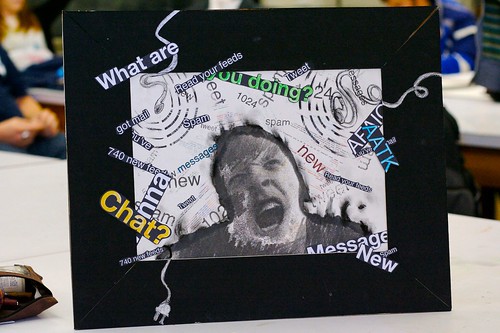
There's no question information bombards us from all sides every waking hour, every day. But what's interesting is exactly how much information we consume.

The University of California at San Diego even studied this aspect of our culture, and was able to put a number on it.

According to this recent study, the average American absorbs 34 gigabytes of information every day.

No wonder people flip out a lot.

Think of it this way. The netbook I'm typing this on has a 160-gigabyte hard drive. Assuming I'm average (don't even go there), my brain would fill that hard drive in 4.7 days. I carry an 8-gigabyte flash drive in my pocket, and just my average daily activity would fill more than four of them. And if I tried to stream all this stuff on either my laptop or desktop? Forget it. The computer would melt.

In 2008, American brains processed a grand total of of 3.6 zettabytes of information. That's 3.6 billion trillion bytes, and there's no hard drive available to harness all of this.

Now, this information isn't limited to computer usage, but includes what you watch on the tube, what you read, what you listen to, and what goes through your telephone. In fact, television is still far and away the biggest purveyor of all this material. That's a lot of Fox News, infomercials, Seinfeld reruns, HBO, and WWF.

This study doesn't really consider the quality of the information processed. Information is information whether you're watching Gilligan's Island or The History Channel, surfing Web porn or the MIT open courseware site, reading romance novels or the Bible, listening to the pop diva du jour or John Coltrane. That's not differentiated in this study (although you may want to keep in mind my argument of finite capacities when deciding exactly how to fill your brain).

From Engadget:

... in terms of time, the study found that Americans spent about 11.8 hours a day consuming information in one way or another, the majority of which was spent staring at a screen of some sort -- and, yes, they did take HD content into account, but its growth apparently hasn't yet resulted in a huge jump in data consumption ...

Again, no wonder people are bad to flip out. I've argued that the human mind is like a hard drive, with a finite amount of storage space. The more crap you load into it, the less room there is for really important stuff. And when you're completely blasted by information, it can't be good for your mental healh. A person does need to get away from all this stimuli every once in a while, just to vegetate on the front stoop in his undershirt. Without the newspaper or phone.

I think it was Einstein who suggested a person should never remember something that is just as easy to look up, and he truly lived by that credo. The legend is that he couldn't remember his own address. I don't remember phone numbers myself -- not even my own -- but I don't need to because all that stuff is right there on my cell phone. Now I just need to remember which button to push ...

But despite my own best efforts to chill out every once in a while, I don't feel right if I don't have my cell phone on my hip, or a computer close by. When my portable mp3 player died a few weeks ago I thought I'd go crazy, but I've come to enjoy a little silence every now and again.

I'm not sure where I fit among the national average. I have a TV, and I think it works, but I never turn it on (thinking of using it as a monitor for a music server). But I have music playing nonstop when I'm home, so that accounts for a fair bit. And I'm at this computer a lot, but most of the stuff I deal in is straight text and minimal graphics. But it's a lot of text -- just my daily RSS news feeds (which is the bulk of my computer activity) accounts for more than a thousand headlines that I scan every day.

If I was to do a word count of my whole day, I don't even want to think about that. Maybe someone else is studying that. Whatever it is, don't tell me.

###

(art from flickr, by DeaPeaJay)

Saturday, December 12, 2009

Manufacturer to leave USA, blames anti-business climate

Emerson Electric, the nation's largest manufacturer of electronic devices, is considering leaving the country.

Although the recession is a partial reason, Emerson CEO David Farr blames high taxes and regulation in the United States.

The federal government is “doing everything in [its] manpower [and] capability to destroy U.S. manufacturing,” Farr said at the recent Baird 2009 Industrial Conference in Chicago.

In comments reported by Bloomberg, Farr added that companies will continue adding jobs in China and India because they are “places where people want the products and where the governments welcome you to actually do something. I am not going to hire anybody in the United States. I’m moving. They are doing everything possible to destroy jobs.”

Interesting ... very interesting. We've seen companies pulling up stakes for several years, outsourcing their work out to some third-world country where someone will bust his tail for less than a buck an hour. We've bemoaned all the layoffs that have slashed companies since the economy went into the toilet a year ago, and we've heard a passel of excuses. But what we're hearing from Farr is pretty much the straight stuff.

Want to kill a business? It's easy if you're in power. Regulate them like crazy, and tax them buttless. They'll get the hint and go to friendlier surroundings soon enough, taking their jobs and tax revenue with them.

Emerson's no lightweight in the industrial world. In 2007, the St. Louis-based corporation reported revenues of $22.5 billion, making it the 111th largest company in the United States and easily pacing the home-grown electronics industry. The closest competitor in electronics is Whirlpool, the country's 127th largest company with revenues of $19.4 billion.

###

Tuesday, December 8, 2009

Global warming: Y'all stop breathing; it'll damage the Earth

Representatives of more than 150 nations -- including 100 heads of state -- are conspiring with our future in Copenhagen this week.

At issue is this so-called global warming, which may or may not be a real issue, but the evidence itself is completely discredited.

I've made my stance known on global warming. Yes, the planet does seem to be getting a bit warmer. I'm basing my assertion on tidal activity I've noticed here in Charleston over the past 12 years, plus some of the footage I've seen of shrinking and/or fracturing polar ice caps. I'm leaving myself lots of wiggle room here, though, as I could just be full of it.

Now, here's where things get murky. The planet has its history of fluctuating temperatures, and as recently as 1985 scientists were suggesting we were on a cooling trend. This truth is a big reason why they're no longer calling it "global warming," but "climate change," thereby making the issue even more nebulous.

Because of this history, I'm a lot less sure of the computer models the self-appointed global warming experts use to predict an apocalyptic disaster.

And will someone please tell me, just what is the optimum earth temperature? Are we like the Three Bears here -- too hot, too cold, or just right?

While I believe human activity is a factor in these fluctuations, it takes a gigantic leap in logic to say carbon dioxide is a factor. CO2 been one of the byproducts of animal and human life. Humans have been breathing since they first appeared on this planet. Cattle have been burping and farting since they got here. And to call it a dangerous pollutant? Well, I'm not going to go out of my way to suck up a cylinder of pure carbon dioxide, but these global-warming activists are gonna have to try again.

We continue to breathe and pass gas, and we still burn our fossil fuels. But our use of energy is a lot more efficient than it was a generation ago.

And the more they bloviate about climate change, the more carbon dioxide is expelled.

I mentioned flawed evidence here, and a bunch of intercepted emails indidate much of this evidence is completely manufactured. Full of it. Created out of wishful thinking and perhaps a political agenda.

To give an idea how politically charged this whole thing is, consider these points:

- The mainstream media completely ignored stories of manufactured evidence, and only started coverage after being so thoroughly humiliated by the alt-press.

- Sen. Barbara Boxer called for the heads of -- not the people who created the bad evidence, but the folks who leaked the emails. Sort of like the way Daniel Ellsberg was treated by the government in the early 1970s after he leaked papers showing how misguided and out of control the Vietnam War was. The party line then, as now, is to shoot the messenger rather than address the message.

But instead of stepping back and rethinking the validity of the evidence, the climate-change doom-shouters continue to further their agenda, giving no trouble to what these bothersome little facts might say.

Meanwhile, the folks in Copenhagen are, like I said, conspiring with our future. Part of this future will certainly include "transferring wealth" and technology by fiat to lesser developed countries, all in the interest of mitigating the damage done by climate change. Which makes no sense whatsoever.

But when you look at this whole process as nothing but a global power grab, then it all starts to make a bunch of sense, and very quickly.


###


Monday, December 7, 2009

Dallas paper goes where I hoped industry would never tread

If it sounds like I'm dancing on the grave of the newspaper industry, you may be right. But while the industry isn't quite dead yet, the Dallas Morning News is shoving it in its own coffin.

I saw a News York Times article which tells how some of the Dallas newspaper's editors are now reporting to the advertising department.

It's something I hoped I'd never live to see.

Old-line newsmen who are still slogging out the deadlines may be wondering what they're still doing in the business, and old journalists who got out of the racket -- like I did some years ago -- are merely watching and sagely nodding their heads.

Maybe I'd better explain why this is so signfiicant before I go on. For a long time, newspapers had the strangest, most conflict-ridden business model imaginable in a free-enterprise society.

Understand, advertising pays the freight, keeps the presses running, and keps the newsmen fed. But except for the weekend coupon clippers, no one buys a newspaper to look at the display ads. Your readers want to know the news in your town, or at the very least, who got caught.

And to accomplish the "real" job of a newspaper -- to keep the readers informed of the world around them -- it is necessary to keep a great gulf between the advertising and editorial staffs. I've always preferred stringing some razor wire between the two departments and electrifying it. An effective editor keeps the advertising sales crew out of the newsroom, and not always nicely.

Here's a purely hypothetical f'rinstance. Let's say you're a reporter, and you catch the mayor of your town with his hand in the cookie jar. Or maybe he makes some decision that is clearly not in the public's best interest. You report it, right?

Now let's mix up the equation a little. Your mayor has a construction company or a pet store (I almost said a cat house, but let's keep this clean). And his business is your newspaper's biggest advertiser. And maybe he's a friend of your publisher, you know, the guy who signs your paycheck.

What would you, the reporter, do?

Guaranteed, your advertising department will swarm the newsroom, begging you to kill that story, reminding you that they are the ones who pay your salary. And you sure won't get any backing from the publisher.

OK, that's a bigger example, but not at all farfetched. I've faced this moral dilemma more than once, which probably explains why I moved from newspaper to newspaper a lot. A likelier scenario is that a potential advertiser may want some incentive to buy ad space -- can you sweeten the pot a little by running a story on my business?

As I got older and more cynical in the business, I'd consent to have the pot-sweetening story run -- as long as the advertising representative writes it and his name goes on it. But one time a funny thing happened -- the ad rep turned out to be a decent writer with good news instincts. So I stole him. Our ad depatment lost a below-average salesman, and I gained a better-than-average reporter. But that was extremely rare back then -- the mindset of a reporter and that of an ad geek were polar opposites. As it should be now.

For the most part, though, a newspaper that pays more attention to the bottom line will lose all its credibility. That's a promise. A real newspaper is independent, and there's no real difference whether this independence is broken by political or financial pressure. And credibility is a funny thing. It's something that takes a long time and much effort to build, but a mere perception can shatter it.

So you can already see my frosty outlook when I saw the Media Bistro article. I shot it over to my old managing editor, Charlie Hand. Now, it's been 21 years since I've worked with Charlie, but he clearly made an impression on me. He, along with the late Verne Peyser, were my mentors. Both preached things like integrity, honesty, accuracy, objectivity -- all those things your grandpappy might have told you about. Values that were the news industry's modus operandi as recently as a generation ago.

Anyway, Charlie fired off a response within the hour, and you can tell he wasn't pleased. He's still in the business, with a small newspaper in southern California. I don't know how he'd do in one of the larger newsrooms today -- probably would be in the way if he wasn't such a good newspaperman. And I shudder to think what Verne Peyser would say about the Dallas Morning News. Even under the most pleasant of circumstances, drunken longshoremen and truckers would complain about Verne's language.

Now, as I see the shape of the newspaper industry, there's not much credibility. You saw how obvious that was in the recent presidential election, though that had nothing to do with whether the writers were liberal or conservative. No, this lack of credibility has everything to do with its honesty, accuracy, objectivity, and independence. There isn't any.

While this is going on, Rep. Henry Waxman (a Democrat from the People's Republic of California) is saying the government should help the newspapers stay viable. "The newspapers my generation has taken for granted are facing a structural threat to the business model that has sustained them," he said.

OK. Let's connect some dots here. The only kind of "help" the government knows how to give is either through regulation, or a financial bailout. The smart money is on the latter, but as soon as the government feels it has a financial stake in the media, the newspapers will be as honest, forthright, and independent as Pravda, the house organ of the old Soviet Union.

I don't know about you, but a government-run press -- or even a press that's subsidized by the government, which is exactly the same thing -- scares the dog squeeze out of me. So much for a wide-open society where people can make informed decisions from relatively untainted information.

Meanwhile, here is a sampling of headlines from the last few days, outlining the state of the media:

Washington Times Cutting Staff Up to 40 Percent (Media Bistro, Dec. 3, from Politico).
Congressman: Struggling Media Will Need Government Help (Media Bistro, Dec. 3, from AFP).

NYT Regional Media Group Pay Cuts to Stay in Effect in 2010 (Media Bistro, Dec. 3, from Poynter).

FTC Examines Possible Support of News Organizations (Media Bistro, Dec. 2, from the Wall Street Journal).

As Times Staff Shrinks, Blogs Will Be 'Pruned' (Media Bistro, Dec. 2, from The Observer).

New Round of Cutbacks Coming at Gannett Newspapers (Media Bistro, Dec. 2, from AP).
We're talking a newsroom staff cut of five percent here.

Tribune Gets More Time to File Reorganization Plan (Media Bistro, Dec. 2, from LA Times).


Had enough? So have I. And that's just two days.

So, there's no great surprise that the new cyber-media -- mainstream news sites. alt-news sites, and blogs are cutting today's newspapers into cat food. And as much as I hate to say it about an industry I've had a stormy love affair with, will someone please put it out of its misery?

So as I sit in my living room late Sunday night, pounding away on my laptop, putting together this blog, I am forced to reassess my position.

Yes, I AM dancing on the grave of the newspaper industry.

###


Monday, November 30, 2009

GOP trying to restrain its rogue elephants

I don't know if they're trying to clean up the party or just pass around the Kool-Aid, but the GOP is trying to cull those who aren't "one of them" from those who are.

Understandable, because the John McCains and Lindsey Grahams of this world are, well, they dress like Republicans but few are really sure who they are.

Future candidates may have a litmus test to determine where they're coming from, and the gold standard by which Republicans may be judged is none other than Ronald Reagan. The party drafted 10 questions to ask each candidate during the vetting process, and a failing grade (in this case fewer than eight out the 10 questions) is likely to cost them funding and endorsements.

Guys like McCain and Graham (who represents South Carolina in the Senate) are sure failures in the political quiz. As are a majority of the party's office holders, I'll wager. But Graham in particular is being branded as a RINO, Republican In Name Only, for his stances on health care and illegal immigration.

Which makes sense on the surface, but the party may be shooting itself in the foot here. Columnist Kathleen Parker calls the litmus test a "suicide pact."

The ultralib Daily Kos is having fun with this one, and one of its writers, in a tongue-in-cheek article, suggested its own litmus test for Democrats:

... out of pure bullet-point envy, I propose that Democrats must also have their own list. Ten litmus tests which every potential Democratic candidate should be able to ace before they ever hope to put (D) after their names. In fact, I'll go so far as to be more pure than the Republicans. If you can't pass every one of these tests, don't bother to sign on ...

Some of the Kos points include:

... (1) We support the rights extended to Americans extended under the Constitution. All the rights. For all Americans ...

I can't say I recollect the Democrats ever being all fired-up over the Constitution, but that's a separate rant. Let's move on:

... (5) We support American business, and recognize that an unregulated market is an unfair market, an unstable market, and a market doomed to failure ...

I'm trying to ignore the contradiction in that statement. To continue:

... (9) We believe that access to our government is not for sale. Not in the courthouse, not in the White House, and not in the legislature ...

Two words for y'all: BILL CLINTON! As in, Lincoln Bedroom. Remember?

To be sure, the conservative (Reagan) wing of the party really didn't have any muscles to flex until 1980. Before that, Barry Goldwater was the lone "real" conservative in a party that would surely flunk the litmus test today. And Goldwater was considered dangerous, a bomb-thrower, and not politically correct anyway. But after Reagan, there were few "real" conservatives to be had in the party -- surely not Bush Sr. or Jr. You'd have to drill deep among the also-rans in the 2008 primary to find one in Mike Huckabee, and even he's a little suspect.

To look at the GOP's history over the past 50 years, Reagan was the aberration. The party itself, well, it was hard to tell them from the other guys a lot of the time.

While it's nice to develop some sense of unity and identity, it's a real mistake to treat the party as a private club. In all its attempts to seek definition, the party will completely kiss off all the independents who are a better fit on that side of the two-party system. While they're about it, they might as well save time and concede the 2010 and 2012 elections right now. The party's in serious trouble right now; you don't fix that by narrowing your scope.

Let's say (purely hypothetical here; there's no way I'd even consider doing such a thing -- I'm already considered a loose cannon in some circles) I decided to run for Congress. Let's say it'll be in one of those nonexistent districts that were created by the recovery.gov website in the stimulus. There's no way I'm gonna pass that litmus test, though my politics are certainly closer to the Republicans than the Democrats. So I might as well forget about funding, endorsements, etc. The GOP wants a Reagan clone, and that ain't me.

See, I told you this is a stupid scenario.

More intelligent (now that's a stretch) voters are more likely to look at the candidate instead of the party. Anyone who goes into the booth on election day and chooses his candidate solely by the presence of a "D" or "R" beside the name isn't smart enough to vote anyway.

I've suggested this before. The two-party system is one of those things that was a real good idea at the time, outlived its usefulness, and is still hanging around searching for relevance. Sort of like the electoral college.

OK. So who's an elephant these days? And who's a RINO?

Eleph-ino.


###

Saturday, November 28, 2009

Going paperless is possible, but is it practical?

How much has technology changed our lives?

I saw an indication when reading John Grisham's latest legal thriller, The Associate. There's an exchange between two old college buddies, Kyle and Joey. Kyle is under surveillance (part of the story, of course), so he goes to old-school methods to contact his buddy ... like writing a letter. Joey answers:

"What's with the snail mail? Your handwriting really sucks ... my hand is aching and I feel like such an old fart writing with ink."

It sounds left-field futuristic, but we are moving toward a paperless society, bit by bit. I guess you can say fewer trees are being killed to cover our daily needs, but a lot more electrons are dying in agony.

A productivity blog called Dumb Little Man recently ran a piece about steps one can take to eliminate paper use in his or her life. And while I'm using a lot less paper these days, I'm not completely paperless. Nor do I plan to be.

I haven't owned a printer in years. It's not moved any higher on my shopping list, either. The last time I owned a printer, I went through a ream of paper every month or two. Most of that printing was unnecessary, now that I think about it. About the only things I need to print now are my resume (a factor now that I'm in job-search mode), charts to songs I'm learning, the occasional letter, and that's about it. If I need to get something printed I can put the photos on a thumb drive and get that done anywhere.

Here's where Jay Scarrozzo, who wrote the DLM piece, suggests technology can take the place of paper:

- Books: DLM is big on the idea of ebooks and their offshoots. If you have something like an Amazon Kindle, you can load some 1,500 full-length books onto your handheld device and take it with you. I understand you can even download the Kindle software onto your laptop and save a step there. A whole lot less paper, no clutter, no bookshelves ...

... you can have it.

I do have a few books loaded on my computers -- mostly old ones from the free Project Gutenberg site -- but I can't get interested in a full conversion to electronic reading. I like the weight of a book in my lap. I like the feel and smell of the paper. The mere act of turning the page of a really good book is like opening another gift. I can shove a bookmark wherever I want and do something else -- like read another book. I'll often have three books going at a time; does that make me ADHD?

When I read, I'm a big annotator and use high-lighter pens liberally, which are habits that don't lend themselves well to electronic books.

So while I find the idea of e-book readers intriguing, they're for other people.
- Magazines: I don't have many at all, and I used to be a big magazine reader. I can go on line to get most of that information, and the magazine industry is dying even faster than newspaper publishing.
- Newspapers: That used to be a daily habit, and back then I'd get two or three of them -- one for local news and one for national. But somewhere I skipped the next logical step, going to the newspaper's web site for my daily fix. Today, I RSS everything. My daily news feeds include the New York Times, Reuters, Associated Press, the local newspapers,and just about everything else. The last newspaper I bought was 10 days ago, and I know that because it's still on the couch, half-read. But folded neatly.

- Sticky notes: Dumb Little Man suggests using your smart phone (for those who have one) or even the notepad feature on your regular cell phone (that's for the rest of us rabble). All phones have that feature now, but by the time I find my electronic notepad, get to it, and start typing on the keypad, I've already got it down on a real index card. Pass. I have experimented with some Web services that will take a phoned-in note and transcribe it into text, and while there's a geekiness factor there, I'd rather have my million-dollar idea down on paper.
- Notepads: Here's another area where you're not going to see me change much. While I do most of my writing -- including first drafts and outlines -- on a computer, I still rough out ideas on a legal pad. I'm also big on making lists and writing little notes to myself, and I always have my Hipster PDA (nothing more than a bunch of index cards held together with a binder clip; the ultimate in understated cool) with me.

- Bills: I get one, from the electric company. But they also send me a paper bill at the same time, so there's no change in the amount of paper used.

- Checks: I write two a month, for rent and for my electric bill, and I have the folks at the bank do that. I can't remember when I last wrote an actual check, but it's not because I've gone high tech. In fact, I went the other way. Nothing beats cash.

So I'm using less paper than I used to. I notice it in my waste stream. I only need to bring my trash can out for pickup every couple of weeks, unless I just cleaned out the fridge. But I'm noticing I'm less of a pack rat than I used to be, because there's less to pack. My desk actually has some clear spots on it. I have a small work table in my living room, and there are a few things piled on it:

- Three books
- Bottle of water
- Two 5x8 legal pads. One carries notes on a couple of songs I'm arranging.
- One 8x11 clipboard, holding brochures for the local college.
- A pair of pliers. It still escapes me why they're there.
- Receipts I've already entered on my spreadsheet. Why don't I throw 'em out already?
- Two miniature, pocket-sized composition books.
- Sheet music -- some bound, some loose.
- Several pens and high-lighters.
- Shoot, there's even room for a cup of coffee, as long as I'm real careful.

Let's not even look at my bookcase, OK? And I'm not even going to get into hard-disk clutter. Not even going to go there.

###

Photo by burgermac. If you look hard enough under all that paper, you can tell that's a MacIntosh under there.

hipster PDA
wikipedia = RSS