The Column

Showing posts with label urban-legends. Show all posts

Monday, September 14, 2009

Hoax has pretend terrorists attack nonexistent town


We passed the eighth anniversary of the 9/11 attacks unscathed, except for a suicide bombing by a nonexistent group on an equally nonexistent town.

In fact, the only real thing about this "attack" was the press coverage. In Germany, the DPA wire service -- which is similar to the Associated Press -- was all over this one, after an attack on the town of Bluewater was thwarted and The Berlin Boys rap group arrestedin the plot.

Except the town, which reportedly straddles the Colorado River between San Bernardino County, California and La Paz County, Arizona, doesn't really exist. And neither does the Berlin Boys group.

According to Wired:

The work of German filmmakers peddling a satirical movie called Short Cut to Hollywood, the elaborate hoax involved at least two faked websites, a faked Wikipedia entry and California phone numbers for "public safety" officials that were actually being answered by hoaxsters in Germany using Skype ... the hoax has transfixed this country. It prompted a 1,000-word tome on the website of Frankfurter Allgemeine Zeitung, Germany’s most respected newspaper, and even a press conference denouncing the incident by the DPA – the German wire service responsible for first disseminating the news about the "attack" ...

There really is a Bluewater, kinda sorta. Although the "official town website" carries a link to the Berlin Boys and is probably fake, there are some other indicators. Sperling's Best Places lists Bluewater with a population of 331 (counting dogs?) and not much else. Wrapped among the Colorado River Indian Reservation, the nearest California town is Earp and the closest anything is the Bluewater Casino in Parker, Arizona. Earp is so insignificant that I haven't found population figures for the town, but 1,545 people live in the 92242 Zip code, where the town sits. (The Web site ZipSkinny, where I got this information, reports that no schools are listed in that area. That's how small the place is.)

Out there, you just might see roadrunners using oven mitts to pick up lizards on those hot days.

Part of the target's "appeal" is that it's so remote.

... locals were blissfully unaware of the hoax that involved their sparsely populated resort area, whose greatest claim to fame is a nearby casino. Hardly anyone lives on the California side of Bluewater, says Dorothy Randall, who runs the Bermuda Palms RV Park in Earp. There’s no city hall or council. The area is called Bluewater by locals, so it wouldn’t make sense for a suicide bombing to have occurred in town anyway, because there really is no town to begin with, Randall said. "There’s not much here."

I lived in Bullhead City, Arizona for five years (and drove by Earp to get there) but I'd never heard of the place. The only Bluewater I knew was the name of my old voting precinct in Bullhead. I've driven by Nothing (along Highway 93, with a population of 4 and, last I heard, enjoying a renaissance) but never saw a Bluewater.

Like, if the place was hit in a suicide bombing, who'd know?


Monday, September 7, 2009

Of five fw: cell phone tricks, one really works

I love this Internet thing. Through this technology, misinformation can spread faster and stay around much longer than it could have in the Dark Ages of maybe 25 years ago.

Recently I got an email from Mom, one of those wonderful Fw: subjects that make the rounds and some swear is gospel. This missive was a fairly old one outlining some things you can use your cell phone for besides making calls. She forwarded it to my brother and to me, knowing that at least one of us would pick it apart and have an answer. Here's her preface:

"Hi, Fact-checkers! Is this stuff valid? If so, it could be useful information. Thanks for checking for Ol'Mom! All my love, Mom"

I did this, partly by running my own tests, and partly by going to Snopes, the great debunker. Here's the upshot: Of these four cell phone claims, four are at least partially bogus.

Anyway, here's the note, with my comments.

====================

Five Things You Never Knew Your Cell Phone Could Do
For all the folks with cell phones. This should be printed and kept in your car, purse, and wallet. Good information to have with you.

There are a few things that can be done in times of grave emergencies. Your mobile phone can actually be a life saver or an emergency tool for survival.

Check out the things that you can do with it:

FIRST Emergency - The Emergency Number worldwide for Mobile is 112. If you find yourself out of the coverage area of your mobile network and there is an emergency, dial 112 and the mobile will search any existing network to establish the emergency number for you, and interestingly, this number 112 can be dialed even if the keypad is locked. Try it out.

My comments: This might work, if you're in Europe. According to Snopes, 112 is their version of our 911. I tried it here in South Carolina and the recorded message indicated the number has been changed or disconnected. In other words, it's every bit as useful as some of the other "alternative" emergency numbers you may have read about in your email box. I wrote about this some time ago, as a matter of fact.


SECOND Have you locked your keys in the car? Does your car have remote keyless entry? This may come in handy someday. Good reason to own a cell phone: If you lock your keys In the car and the spare keys are at home, call someone at home on their cell phone from your cell phone. Hold your cell phone about a foot from your car door and have the person at your home press the unlock button, holding it near the mobile phone on the ear end. Your car will unlock. Saves someone from having to drive your keys to you. Distance is no object. You could be hundreds of miles away, and if you can reach someone who has the other 'remote' for your car, you can unlock the doors (or the trunk). Editor's Note: It works fine! We tried it out and it unlocked Our car over a cell phone!

My comments: It's just another good reason to avoid those bad drugs before going onto the Internet.

THIRD - Hidden Battery Power. Imagine your cell battery is very low. To activate, press the keys *3370#. Your cell phone will restart with this reserve and the instrument will show a 50% increase in battery. This reserve will get charged when you charge your cell phone next time.

My comments: Doesn't work with my LG. Dial it in and hit OK, and the phone stares at me. Dial it in and hit SEND, and all I get is an admonition to check the number and try again. But, some cell phones (particularly Nokia) will give you better battery life if you punch in *#4720# - but there's a trade-off. Your sound quality will suck. Not quite the same thing.


FOURTH - How to disable a STOLEN mobile phone: To check your Mobile phone's serial number, key in the following digits on your phone: *#06#. A 15-digit code will appear on the screen. This number is unique to your handset. Write it down and keep it somewhere safe. When your phone get stolen, you can phone your service provider and give them this code. They will then be able to block your handset so even if the thief changes the SIM card, your phone will be totally useless. You probably won't get your phone back, but at least you know that who ever stole it can't use/sell it either. If everybody does this, there would be no point in people stealing mobile phones.

My comments: I tried this on my LG phone, and got the same result as I did while trying out the third tip. But it seems that with some cell phones you will get that 15-digit number. Whether it's any help in shutting down a stolen cell phone is "limited," the folks at Snopes report. Better to call your phone carrier's customer service and explain your situation; the guy answering may even speak English.

And Finally.....

(My comment: Good -- that's about all the crap I can choke down at one sitting!)

FIFTH - Free Directory Service for Cells: Cell phone companies are charging us $1.00 to $1.75 or more for 411 information calls when they don't have to. Most of us do not carry a telephone directory in our vehicle, which makes this situation even more of a problem. When you need to use the 411 information option, simply dial: (800)FREE411, or (800) 373-3411 without incurring any charge at all. Program this into your cell phone now.

My comments: I do have this on my cell phone, along with Google 411 (the number is 800-466-4411), and I've never used either one. Therefore, I can't vouch for the authenticity here. But according to Snopes, this is pretty much the straight stuff although your own cell phone carrier may still charge for the call.

==========================

OK. I'm fairly savvy with all this electronic gear, and there are a few things I can do with my plain-vanilla cell phone. I can post short subjects to my blog. I can send off something to Twitter. I can check the weather, or put things on my Google calendar.

But forget about opening your car with it, unless you fling it through the windshield ...


Hoax: Break it to me gently?

I found this recently in Lifehacker, and it ties in well with this other posting. Here goes:

How Can I Explain an Internet Hoax to Non-Techie Friends? ... When it comes to hoaxes and non-techie users, being gentle is really the wrong tactic. It's only a matter of time before they fall for something that actually harms them, by stealing their information, or something else. They need to learn, and quickly ... personally I reply all with a link to Snopes or elsewhere, explaining that it's a hoax. Then I include this line: "Every email that asks you to forward to all your friends is a hoax, or a joke by somebody that just wants to clog people's email."

Here's the original article, which was in the Superuser forum. Interesting stuff, by the way.

Good, sound advice. Personally, I get an itchy trigger finger when I get emails marked Fw:, and that finger hovers over the DELETE key. Sure, some of the Fw: stuff is funny, some is inspiring, and much of the photography that gets forwarded to me is flat-out stunning (current screen background is an airborne shot of the Blue Angels, which I got from that slush pile). I've written plenty of columns from something I got in FW: land. But any computer advice, or any rumor, or anything that may seem important -- check it out.


Saturday, September 5, 2009

Problems and solutions on the wing

This was sent to me some time ago, and yeah, this is my kind of humor.

These communications, by the way, are totally unsubstantiated (you know how much garbage finds its way onto the Internet), so I can't vouch for their authenticity. Let's get that up front.

With that, these are purported to be communications between pilots and mechanics of the United Parcel Service air fleet. So suspend your belief/disbelief for a minute and enjoy. You can do that, can you?

==========

Remember it takes a college degree to fly a plane, but only a high school diploma to fix one; a reassurance to those of us who fly routinely in our jobs. After every flight, UPS pilots fill out a form, called a 'gripe sheet,' which tells mechanics about problems with the aircraft. The mechanics correct the problems; document their repairs on the form, and then pilots review the gripe sheets before the next flight.

Never let it be said that ground crews lack a sense of humor. Here are some actual maintenance complaints submitted by UPS ' pilots (marked with a P) and the solutions recorded (marked with an S) by maintenance engineers.

By the way, UPS is the only major airline that has never, ever, had an accident.

P: Left inside main tire almost needs replacement.
S: Almost replaced left inside main tire.
*
P: Test flight OK, except auto-land very rough.
S: Auto-land not installed on this aircraft.
*
P: Something loose in cockpit
S: Something tightened in cockpit
*
P: Dead bugs on windshield.
S: Live bugs on back-order.
*
P: Autopilot in altitude-hold mode produces a 200 feet per minute descent.
S: Cannot reproduce problem on ground.
*
P: Evidence of leak on right main landing gear.
S: Evidence removed.
*
P: DME volume unbelievably loud.
S: DME volume set to more believable level.
*
P: Friction locks cause throttle levers to stick.
S: That's what friction locks are for.
*
P: IFF inoperative in OFF mode.
S: IFF always inoperative in OFF mode.
*
P: Suspected crack in windshield.
S: Suspect you're right.
*
P: Number 3 engine missing.
S: Engine found on right wing after brief search
*
P: Aircraft handles funny. (I love this one!)
S: Aircraft warned to straighten up, fly right and be serious.
*
P: Target radar hums.
S: Reprogrammed target radar with lyrics.
*
P: Mouse in cockpit.
S: Cat installed.
*
And the best one for last
*
P: Noise coming from under instrument panel. Sounds like a midget pounding
on something with a hammer.
S: Took hammer away from midget.


Wednesday, August 26, 2009

Gmail account note probably work of fools

I've had Gmail accounts for several years now, and just today I received a most disturbing message:

Dear Account User,
This Email is from Gmail customer care and we are sending it to every Gmail accounts owner for safety. We are having congestion due to the anonymous registration of Gmail accounts so we are shutting down some Gmail accounts and your account was among those to be deleted. We are sending this email to you so that you can verify and let us know if you still want to use this account. If you are still interested please confirm your account by filling the space below.Your User name, password, date of birth and your country information would be needed to verify your account.
Due to the congestion in all Gmail users and removal of all unused Gmail Accounts. Gmail would be shutting down all unused Accounts, you will have to confirm your E-mail by filling out your Login Information below after clicking the reply button or your account will be suspended within 24 hours for security reasons.

* User name: ............................

* Password: ................................

* Date of Birth: ............................

* Country Or Territory: ....................


Warning!!! Account owner that refuses to update his or her account within Seven days of receiving this warning will lose his or her account permanently.
Thank you for using Gmail !

The Gmail Team
G MAI L BETA


Anyway, that's the message.

So far as I know, it's all crap.

Just swallow down that bile rising in the throat for a moment, OK?

A couple of things:

Why anyone would want my account name and password is beyond me, unless it's for nefarious purposes.

Check it:

If it was from Gmail, they'd already have all that.

Got it?

I had a partial answer here, which if nothing else confirmed what I'd already figured.

So if you have gmail and received that message, ignore it. Keep in mind, that's what happens when we have idiots on the Internet.

(Posted simultaneously in The Column, Reloaded and The Workbench, Reloaded)


Friday, July 31, 2009

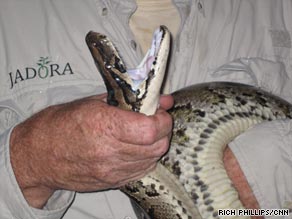
Jumbo snakes multiply in Everglades

Reptile expert Joe Wasilewski holds a Burmese python he found in the Florida Everglades.

OK, the snaky frame of mind continues.

According to CNN, very large snakes are breeding like mad all over Florida, and it's tough keeping track of them.

Here's an excerpt:

Joe Wasilewski drives along a narrow stretch of road through Florida's Everglades. The sun is setting, night is coming on quickly, and Wasilewski is on the prowl for snakes -- and one snake in particular. "The next 10 miles seem to be the hot spot for Burmese pythons," he said ... Wasilewski is a state-sanctioned snake-hunter who regularly scours this area for the reptiles. The Everglades, known as the River of Grass, has the perfect space and climate for pythons to hide and breed. And breed they do: The largest clutches found in the Everglades have contained 83 eggs ...

Perhaps a little self-vindication here: I covered this issue a year ago. An excerpt:

The southeast coast is indigenous to a wide variety of snakes. Rattlers could be seen out here, as well as copperheads, water moccasins, and land developers ... however, the U.S. Geological Survey (USGS) predicts Burmese pythons may take up residence in the southeast -- in fact, the entire southern third of the country within the next hundred years, if there is indeed a warming trend as all evidence suggests. It's a comfort to know Burmese pythons are not poisonous snakes. A good thing; there are plenty of those kind around here. What's not so comforting is that pythons are just plain big. Big enough to hunt deer and alligator. Try 20 feet long and around 250 pounds. That's one big piece of reptile ...

Stay tuned. Not all snakes hang out in D.C.

(Photo from CNN)

Wednesday, July 1, 2009

It's getting harder to tell who's really dead


Britney Spears: Dead or alive? (Photo from CNN website)

Like Mark Twain once wrote, rumors of his demise were greatly exaggerated. But with the anything-goes, who-gives-a-rip "news" style on the Internet, it'll be even tougher filtering out the real news from the horse manure. From CNN ...

(CNN) -- After a string of real celebrity deaths last week, the Internet and online social networks killed a few more stars.

Pop star Britney Spears was among those falsely claimed to be dead recently.

Despite what you may have read, Jeff Goldblum, Natalie Portman, George Clooney, Britney Spears, Harrison Ford and Rick Astley are alive ... fake news of their deaths flew across the Internet -- particularly on online social networks like Twitter and Facebook -- after Michael Jackson, Farrah Fawcett and Ed McMahon were reported dead.

Friday, September 19, 2008

A living example of 'Fly United'


It's October and love is in the air in the Southeast -- with a cloud of particularly amorous flies.

Known as the lovebug (Plecia nearctica) and actually a fly (kin to the May fly), they're out in full force for their twice-a-year (sometimes) stage show. Lovebugs travel in pairs, locked together at the end of the abdomen, and spend their adult lives in a sort of airborne ecstacy -- not even bothering to eat.

This week they've been everywhere, doing the thing that they do. And getting in the way. And spreading scandal everywhere. Copulating on my shirt. Boffing on my head. Fornicating on my work equipment. As if I'm not even there.

I did see one unattached lovebug land on the bench at work, but it didn't stay in that condition for very long. While I pondered where the wheels might have fallen off my own love life, a second unattached lovebug dropped down, and in one smooth motion they coupled. He didn't even bother to buy her a drink first.

According to Wikipedia and other sources, these lovebugs spend most of their lives as larvae, living in tall grass, well hidden. As adults, the females live only two days, but they make the most out of that short time.

I first saw these lovebugs within days of my arrival in Charleston back in 1997. I'd never seen anything like that before, and of course I had to ask around. Strangest things I've ever seen.

Lovebugs have two mating seasons, in the spring and the fall. Sometimes they keep a lower profile; one year you might not see any while the next year you could see a lot of them. Their off-and-on appearance -- not to mention their oversexed behavior -- lends itself to its share of urban legend. One story has it that they're not a real species; they're a genetic experiment gone bad at the University of Florida. A variation I've heard is that they're created by Monsanto to keep mosquito populations down. Untrue, say the folks at snopes.com. They are a real species, indigenous to Central America, and may have stowed away on a ship (in the champagne suite?) and landed here. Now, they can be seen along the Gulf coast and lower Atlantic coast, as far north as Wilmington. But they're susceptible to weather patterns -- in the wake of Hurricane Ike there has been an incredible number of sightings along the Texas coast.

Generally, lovebugs are considered harmless. About the only (other) obnoxious quality they have is that a bunch of them may splatter themselves on cars, and their slightly acidic guts can etch the paint job. And yeah, they do get in the way.

Other than that, they're more entertaining than sea monkeys.

Saturday, September 13, 2008

How misinformation gets up and around

It didn't start with much here in Charleston. A few local gas stations posted signs asking customers to limit fuel purchases to 10 gallons.But it started a short-lived panic Thursday, with talk of $5 gas by late afternoon.

The rationale sounded good, anyway. Fuel suppliers were watching as Hurricane Ike hunted for a spot along the Texas coast to hit, and some refineries shut down in anticipation. Offshore rigs were hanging out in the Gulf with all kinds of potential for damage, and things were just plain uncertain.

It's when times are uncertain that rumors really grow legs. In this case, word went out via phone calls, text messages, email, and mouth to ear.

I heard this rumor shortly after 3 p.m. Thursday while at work, and already my coworkers were in panic mode. Nearly all made plans to stock up on gas as soon as they clocked out (I didn't have to worry about it, being on a bike). One of my youngest crewmates lives a fair distance away, recently got an SUV (which never met a gas station it didn't like), and asked to take off for a few minutes to fuel up. Permission granted.

It turns out my coworker got a phone call from a friend who said her uncle's friend's concubine's dog's boss (or something) got an email warning that gas would go up to $5 or $6 a gallon by 5 p.m. That was the gist anyway.

All of which smelled like misinformation, like urban legend to me, and I expressed my doubts.

On the way home I checked out all the gas stations on Rivers Avenue, which is the main drag in North Charleston. We're talking 4:30 to 5 p.m., the front edge of rush hour. Some of the stations were crowded, a little more than usual, but no gigantic lines. Gas stayed at the area's norm, around $3.50 for unleaded. Nothing unusual there. I stopped at a BP on Rivers and I-526 for provisions, and it was the normal level of business there. The normal clientele. As many folks came in for quart bottles of malt liquor as they did for gallons of gas, making it a fairly typical day at that BP.

In other parts of Charleston, my coworkers reported, the gas stations were pretty well crowded Some long lines and a lot of waiting to get to a pump. At least one popular station in the West Ashley area had run out of unleaded fairly quickly. But the prices held steady throughout, which did surprise me.

I can understand, again, the panic. Gas hit a (then) all-time high while Hurricane Katrina was killing people in New Orleans. For the first time here, it topped $3 a gallon, while it was up to $4 in parts of Georgia during the storm.

And, yeah, some of my more conspiracy-minded friends noticed that this was on the seventh anniversary of 9/11, therefore it meant something. I don't buy that one, though.

This one was, to all intents and purposes, pretty harmless. So folks were in a hurry to fillk their tanks? No problem; they're going to use that gas sometime anyway.

Generally, though, this was instructive in how misinformation starts, is disseminated, grows legs, and eventually fades to black.


Here's another take, from a Realtor in Georga:

Saturday, August 23, 2008

Don't forget the hip waders when you surf

I love the Internet. I have to, for I spend so much time on it.

You can't beat it for research. In fact, just about everything you've ever wanted to know is probably in some cranny in cyberspace.

The downside is, just about everything you've ever wanted to know is probably in some cranny in cyberspace.

It's real easy to get crammed up in a state of information overload, even if you're a dedicated RSS'er like I am. I use Google Reader for my news feeds, and right now my reading list is several thousand articles. Of course, I'm not going to read all of them. I might not even scan all the headlines.

But what's even worse is that there's no real way of knowing, on the surface, what's true and what's not. Face it. Most of the stuff you read on the Internet will be pure, unadulterated crap.

That's often what happens when there's such a free flow of information. And the flow is a lot more free than it was even 20 years ago. But you sometimes get what you pay for.

Back in the day, the only way I could write this column so it can be read by more than a handful of people is to hook on with a newspaper. That means polishing up my resume, finding a publisher crazy enough to hire me, and cracking the editorial page. By then I will have been vetted, somewhat. The publisher could make a few phone calls to learn I'm OK as long as I take my medication, that I can be trusted with the news content, and that I wouldn't get drunk and file stories about the UFO landing on my roof. OK, a few Janet Cooks and Jayson Blairs may fall through the cracks, but for the most part the publisher can rest assured he's getting the genuine article (though no promises he's not getting a loose cannon in the bargain, but let's not go there).

Now, it's a lot easier. I just set up an account on Blogspot or some other blogging service (cost: free), set up my graphics, and write whenever I get a hankering to do so. It's up to the reader to determine whether I'm dumping a whole load of snow in his lap, and if I am, so what? Let the buyer (or surfer) beware.

This is why the so-called establishment press holds bloggers with disdain. Anyone can blog, while not everyone can report the news with some semblance of accuracy. A real journalist usually has some sort of college training, and he has to have a certain mindset to do the job. All a blogger needs is a computer.

Iin truth, though, it's a lot harder these days to find real reporters who produce the news without worrying about the consequences. To be done right, the reporter has to either own the presses or be kindred spirits with the guy who does. Either that, or get used to being fired a lot.

Marshall McLuhan, the Canadian thinker who foresaw the global village long before it happened, said it best: "Whereas Caxton and Gutenberg enabled all men to become readers, Xerox has enabled all men to become publishers." MacLuhan has been dead since 1980. What would he think if he was around to surf the Internet today? Might he give up all his credentials and raise hairless chinchillas instead?

Develop enough Internet presence (and really, it doesn't take much for Surfin' Joe) and your email box will soon be crowded with a bunch of communications marked Fw: -- and when I see these, my delete finger gets itchy. About the only exception I make is Fw's from family members, because sometimes they become subjects for ... this blog.

In your Fw's you might get a list of quotes attributed to George Carlin, or something else like that. Not too long ago, I got one from Mom sharing an essay from former Chrysler head Lee Iaccoca. When I get these, I always feel the need to go to the filter: the debunker's site snopes.com. Here are some of the things I checked out:

- Putting I C E (In Case of Emergency) on your cell phone -- true, sort of. It's one of those things that can't hurt.
- Dialing *77 for emergencies -- false, and a total waste of valuable time.
- Most recently, the piece about the USS New York, a ship with some parts made from steel recovered from the World Trade Center site -- it's one of those feelgood stories, and surprisingly, it's true.
- A very scary plug for DriveCleaner, which turned out to be one of the bottom feeders in the computer security industry. OK, this is an older one. It's in my old blog, and you'll need to scroll down. Still relevant.

Warnings and Swiss cheese

My brother Rick (who suggested this subject in a recent email) and I are of the same mind here. I can't remember all the particulars, but it was a virus warning Mom sent along. It was great, well meaning, but it was misinformation. Anyway, Rick and I researched the subject independently, and we discovered the same thing -- it was indeed misinformation. I sent a note to Mom saying so, while Rick went a little further. His missive went out to all the folks on Mom's mailing list, reassuring them that they can enjoy their computers now.

OK, what's the harm in sending out a little misinformation?

On the surface, not much. You, the sender, have your 15 minutes of infamy. It'll be forgotten tomorrow. Besides, there's so much crap on the Internet that looks so good, it's easy to pass something along as the real deal.

But, I'm convinced the more misinformation goes out, the more our brains turn into Swiss cheese. Most people won't trouble themselves to research something; they'll believe it and pass it along instead. But then, many folks will believe something because their favorite pop icon du jour said it's so. That's why Barbra Streisand carries so much weight. Instead of yet another former performer, she's a political pundit. Same thing with Michael Moore, the Dixie Chicks, Paris Hilton, or whoever.

It's already a given that people these days are a lot smarter in some ways, and a lot dumber in others, than they used to be. You can sit and place blame all day long, but what used to be an ironclad set of facts is now elastic. Subjects like history and the sciences are quite unforgiving and narrowminded with the facts -- either something happened or it didn't, either something works in this manner or it didn't. Some things just can't be rewritten no matter how hard you try.

And some things -- yes, like history -- do get rewritten a lot. Back in the days of the Soviet Union, the citizaens were told the Russkies invented the car, television, and anything else of any consequence.

When misinformation is repeated often enough, then a lot more people will take it to be fact. But just because the majority may believe something to be fact doesn't make it so. It doesn't even matter what sources you cite; you still can not change black into white.

Unfortunately, so many people -- and those numbers seem to be growing -- are easily impressed when you mention sources. It makes no difference whether the source knows anything about the subject he's sounding off about. What does a washed-up pop singer know about politics? What inside information does an ultraliberal movie director have on 9/11?

And you say you heard about such-and-such on the Internet? Boy, I'm impressed ...

Let's cut to the chase here. Surf away. Have fun. But keep in mind there's a lot of crap out there in cyberworld, and so much of it sounds good. Surf with your hip waders on. Best to practice that credo that was part of the indoctrination of many an old journalist (with apologies to my own mom, who loves me):

"If your mother says she loves you, check it out."


Wednesday, January 16, 2008

For a change, good online adv(ICE)

The Internet is just full of advice these days and sometimes you’ll even find some that is useful.

I’ve covered some pretty bad advice in some of my blogs – spyware programs that damage your computer, and emergency numbers that don’t work. But since I’m not a complete naysayer and debunker, I’ll discuss one Internet nugget that is actually a good thing.

If you have an email account and friends who send mass mailings, you have probably heard of putting ICE on your cell phone. That’s a directory entry, slugged as ICE (for In Case of Emergency) that you can put on your cell phone and emergency personnel know what it is should you be found unconscious somewhere.

Whether this started out as an urban legend and grew legs to the point where it became fact is immaterial here. It’s one of those things that, well, it won’t replace other means of ID or keeping emergency numbers, it doesn’t hurt either. In fact it might actually save a life, and there’s no price tag for something like that.

This ICE thing came to my attention again, during a phone conversation with my parents in California (this wasn’t the main topic of the phone call, but let’s not go there). Anyway, Mom mentioned that she has ICE on her phone, and I’m one of her emergency contacts.

Although I’m not planning to turn up with real bad amnesia in some strange neighborhood anytime soon, I too have ICE on my phone. In fact, I have returned the favor, as my parents and brother are the contacts listed. The rub, of course, is that none of the kinfolk live anywhere near me.

The last time I needed to contact family members for an emergency was 20 years ago when I went down in a rather spectacular bicycle wreck. Fortunately, all family members lived close by, and I had enough presence of mind (despite the painkillers they gave me) to choose the right family member for the initial call. This is important here. While I love my father and wish I could be more like him (and like me, he just gets better with age), he’s just not the coolest head around when there’s an emergency. So my brother Rick became the go-to guy in this situation.

Whether he wants it or not, Rick is still my default ICE number.

Here’s a trick if you wish to ICE your phone. Lead the I C E off with a punctuation character. Mine shows in the directory as . I C E with the period throwing it to the top of the list. If you make it ~ I C E it will go to the bottom of the directory, which also makes it fairly easy to find. This trick holds true with LG phones like the one I have, and also with Nokia phones. You may want to check your own, though, as your mileage may vary.

One drawback to ICE is that there is just not a lot of room in the directory for all the vital information. There are things like drug allergies, active prescriptions, and other warnings to consider. So I’ve taken the ICE step a little further.

In the “memo” portion of my ICE entry, I have the following: “More info on USB drive in R boot”

OK. This sounds cryptic, so I’ll explain. I carry one of those USB thumb drives with me all the time. All of my work files are on it, plus maybe even a whole operating system if I feel like experimenting. But there’s also a text file, easy to find, and called IN-CASE-EMERGENCY that carries all that information. This drive can be plugged into any computer, and when folks in the emergency room pull it up it has probably all the information they would ask for if I was conscious. Besides the usual run of emergency numbers, this file lists my medications, a bit of history, and allergies. This file is in .txt format so it can be read with any word processor, or no word processor at all.

This USB drive has its permanent home, in a pouch in my right boot, unless I’m using it for something else. Like writing this blog, for example.

As I wrote this, I was somehow remembering a staff requirement at one newspaper where I worked. Each reporter had to have his obituary on file. Seriously. But then, many newspapers back then kept files of celebrity obits – just plug in the date and any last-minute details and run it. This does sound beyond morbid, but there’s a point to it. It does save a lot of hassle.

My editor, the late Verne Peyser, insisted on the obits. “I wouldn’t trust anyone else to write mine,” he’d tell us. Some of the staff obits were real beauties. Usually in an obituary you don’t mention how the person died, but that’s where our imaginations really cut loose. Verne, a chain smoker, was sure that lung cancer would get him. My own self-penned obit had me being electrocuted while pursuing my musical avocation, in mid-solo by a faulty sound system. Or something.

One of our sportswriters blew off the obituary requirement, and just happened to get himself killed in a motorcycle accident in Laughlin, Nevada. We had one hell of a time gathering up all the standard information for the news story. I remember bugging the ladies in personnel for any files they had on him. (As a footnote, I was the last to see this person alive, so the cops told me I may have to ride with them to the Clark County Coroner’s Office in Vegas to ID him, but the trip wasn’t needed.)

Now, I’m not getting that far or that morbid with my USB drive. There is such a thing as Too Much Information.

The USB emergency information may well be a wasted step. This might be as useless as some highly-publicized emergency phone numbers. With my luck the next emergency room I get hauled to is one where they don’t have computers but have lots of leeches, and I don’t mean the ambulance-chasing variety either.

But, like ICE, the USB trick is easy to do costs nothing to implement, and may actually help.

Tuesday, November 6, 2007

Stick with the battle-tested 911 for emergencies

Don't you just love these urban legends? Those that sound so good on the surface -- and might be a real good idea -- but are either premature or pure crap?

Some of these legends are harmless at worst. Others do absolutely nothing but scare the living crap out of people (like the ones that had been making the rounds long before the Internet, about prospective gang members' initiation rites). And other legends may have you jump through a bunch of useless hoops in an emergency.

I got wind of one a couple of days ago, through an email.The story goes like this: It seems Lauren, a young woman, was being followed and pulled over by an unmarked car with a flashing red light on the roof. May be a real cop, may be some real sketchy type, you never know in that situation. She remembered some advice from mom and dad and used her cell phone to call *77, a straight-in number to police dispatch. Within minutes four real cops showed up, stopped the unmarked car, and arrested the driver -- who was a convicted rapist.

Nice story, right? A hell of an idea, too. Only problem is, either it's not true or "Lauren" sure gets around. One version (which showed up on the Internet in early 2002) has Lauren as a 19-year-old coed in Virginia. In 2003, still 19, "Lauren" escapes a similar fate in Australia, where dialing the "Number 112" feature on her cel saved the day for her. In mid-2004, the 19-year-old Lauren is followed again, in Canada, and saves her bacon by dialing *677. And in 2007, Lauren -- still 19 years old -- is in Dorset in the United Kingdom where her handy cell phone bails her out of similar trouble.

Plenty of inconsistencies in Lauren's tale, and already that makes it questionable. But let's skip all that crap and get to the important part of the story. What will dialing *77 get you?

In my neck of the woods, not a damned thing. Calling *77 from Charleston, South Carolina, gives me nothing but a fast busy signal. I tried a variation of the story, with #77, and was informed that my call could not be completed as dialed. (I figured if a real cop answered the phone during my experiments, I could always pretend I'm drunk and trying to call my mom in Truth Or Consequences, New Mexico, or some such fantasy.) So it won't work where I am, and I hope in a real emergency no real time is wasted fiddling with all those 77s. Stick with 911; it's battle-tested.

According to snopes.com, the great debunker of urban legends, some states use #77 as an emergency number while others may use *55, *47, or *HP as an emergency number. Your mileage may vary. If you're out traveling the highways, you might see information signs at roadside or on trucks advertising the number du jour. But to be on the safe side, stick with 911.

Clicking this link will give you a map showing emergency numbers from the states. This was originally put together in 2000 by the Missouri Highway patrol, and is pretty up to date. But this map may not be immediately available in a real emergency and you probably won't have time to pull up this web site, so do yourself a favor. In crunch time when the adrenaline is pumping like mad and you can hear your heart pounding in your ears, forget all that crap and dial 911. At least that works.

One urban legend I run across is the one about putting ICE on your cell phone. The idea here is to have emergency contact information on your phone, and slug it as ICE -- for In Case Of Emergency. Now, I've heard various reviews of this, but this is one of those it-can't-hurt-but-it-may-help things. There are rumors that viruses may target phones that have ICE in the directory, or folks who have it on their cell phones may end up paying higher rates per minute, but to all indications that seems to be nothing but a legend. Again, ICE may or may not be useless, so I have it on my phone. To me, though, what makes more sense is to carry a thumb drive with a text file containing all your emergency and medical information (history, allergies, prescriptions, things like that). These drives are small enough to do that, and maybe someone, somewhere, may take the ICE cell phone trick and merge it with the thumb drive idea. As cell phones get more advanced and have more memory, don't be surprised if a version of this idea becomes reality.

Now, *77 does sound like a great idea. Maybe someone will pick it up and run with it. Sometimes if enough people hear an urban legend it'll grow legs and become truth. Maybe in a few years it will be possible to dial *77 and get a cop. But it's not happening yet, and you sure don't need to be frittering away valuable seconds in an actual emergency.

Stick with 911. At least you know it works.

(For other links, check out the Western Herald and Urban Legend Zeitgeist.)